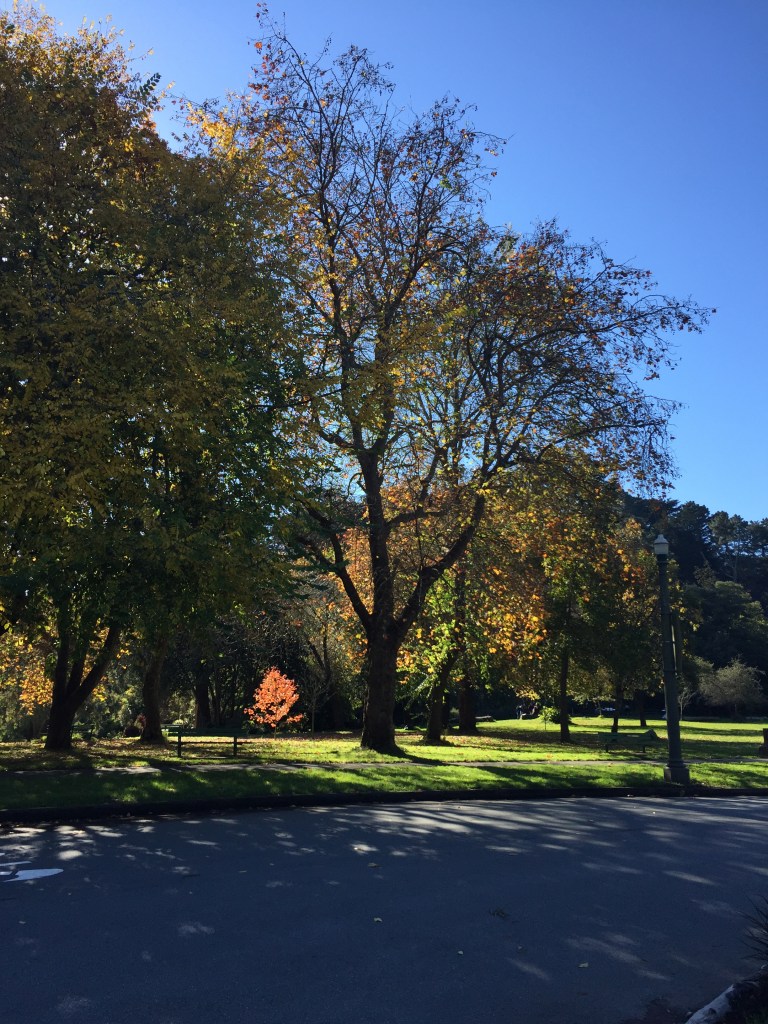
Someone is sitting in the shade because someone planted a tree a long time ago.
Warren Buffet
I walked into the enormous brick building that I hadn’t visited in years. The grand lobby with its 20 foot ceilings had been recently painted in muted grays. Sunlight was streaming in through the large windows on this record warm day in December. There was a large silver cross on the wall where his picture used to hang. Old and new, foreign and familiar mingled in an uncomfortable way as I took it all in. Beyond the front desk, down the short hall, people were gathering for an early lunch in the cafeteria where I had spent so many meals with our own family. Behind the plexiglass an unfamiliar face asked me to sign in and fill out the new decade’s requisite COVID questionnaire.
Walking down halls no longer covered in shag carpet, my cousin and I expressed dismay and outrage that was, in fact, honest and lurking just below the surface, as we laughed awkwardly at the whole damn thing. Our grandparents had envisioned and built this place. From toddlers to teenagers, my cousin and our two brothers had travelled up and down the halls, arms outstretched, feeling the shag-coated walls in blue, orange, green. Each serving as unique visual anchors for where you were in the complex (what their intended purpose was, I myself, was never clear). Now our grandparents were gone. Their name divested from the whole of the residential complex for those that would follow them.
There is much to unpack here for those readers that are unfamiliar – and frankly for those that lived it. I think I’ll explore that in a subsequent post. In any event what I think I know, at this particular moment in time, is this.
Legacy comes from the Latin verb, legare “to appoint by a last will,” “send as an ambassador” and the noun, legatus “ambassador” or “envoy.” At some point, the predominant use became to describe the physical assets (money, property, etc.) a person left behind in their will.
However, the use of the word is currently at its highest levels since the mid 19th-century. I am inclined to think this is usage largely based on the word’s original Latin roots. That perhaps the global pandemic along with increased social awareness, conversations about climate change, and more has gotten us all thinking about our collective interconnectedness, our individual fragility, and what we leave behind when we’re gone.

In the sense of its non-materialistic usage (in particular) legacy is not something that we have full control over – much like the rest of life (which are the building blocks of legacy). It is in fact a highly subjective concept. What I think of a person’s legacy, and what another thinks of it, are likely to be different. And both of those may differ from what the legacy-giver had intended. Judgement of a legacy’s value (be it high or low) is also up for interpretation. Regardless of that fluidity, “leaving a legacy” is highly esteemed and idealized, painful when tattered, talked about often, and perhaps not really understood. Much like the gym, I suspect the majority of humans want the benefits of going, but rarely want to put in the effort.
The thing that you learned about my grandparents the quickest was their love of Jesus. Their legacy, if you were to ask me (and which I will imply by your reading), was one of a life lived to the glory of Christ. In fact, the community they built was named for the Great Commission given by Jesus to his followers recorded in Matthew 28:19-20. “Go” he told them. The latin verb legare, you recall, refers to ambassadors being sent [by commission].
As you got to know them more, you learned of the home they built on the mountain by the lake, the various businesses they owned and operated, including the work of their lives – this retirement community where they lived and died. Resourcefulness, hard work, and creativity marked their lives. The motivation (as I see it) was to show the goodness of God for the benefit of others.
What you do is your history. What you set in motion is your legacy.
Leonard Sweet
There are many things we can set into motion by our actions. Over time, that sequence reveals our “legacy.” One act of kindness on my part, may prompt another to show kindness to others. If I forgive, someone else may follow. The motto for our surname is virtute acquiritur honos. Honor is acquired by virtue. Legacy, like virtue, is made up of a vast number of small decisions that may often seem insignificant. In the end, it is greater than the sum of its parts. Certainly my grandparents knew that and did their best to live that out.
The bricks and mortar will last indefinitely. The memory of the dear couple that brought it into being, will eventually fade. But I’m learning to accept that the building is simply history. An endowment to the community for which I am proud. What was set into motion within that community were decades of friendship, care, laughter, memories, faith.
 The Joy Experiment
Leave a comment